THE CODEX JOURNAL
Your First Ninety Days in Dubai: Build a Decision System
Reading tools & contents
A new environment increases the cost of assumptions
When you arrive in a new city, familiar tasks stop being automatic. Housing, transport, banking, work and everyday commitments may each require choices you have not made in that setting before. Meanwhile, the desire to feel established encourages quick commitments. The result can be a life assembled to reduce uncertainty before the underlying assumptions have been checked.
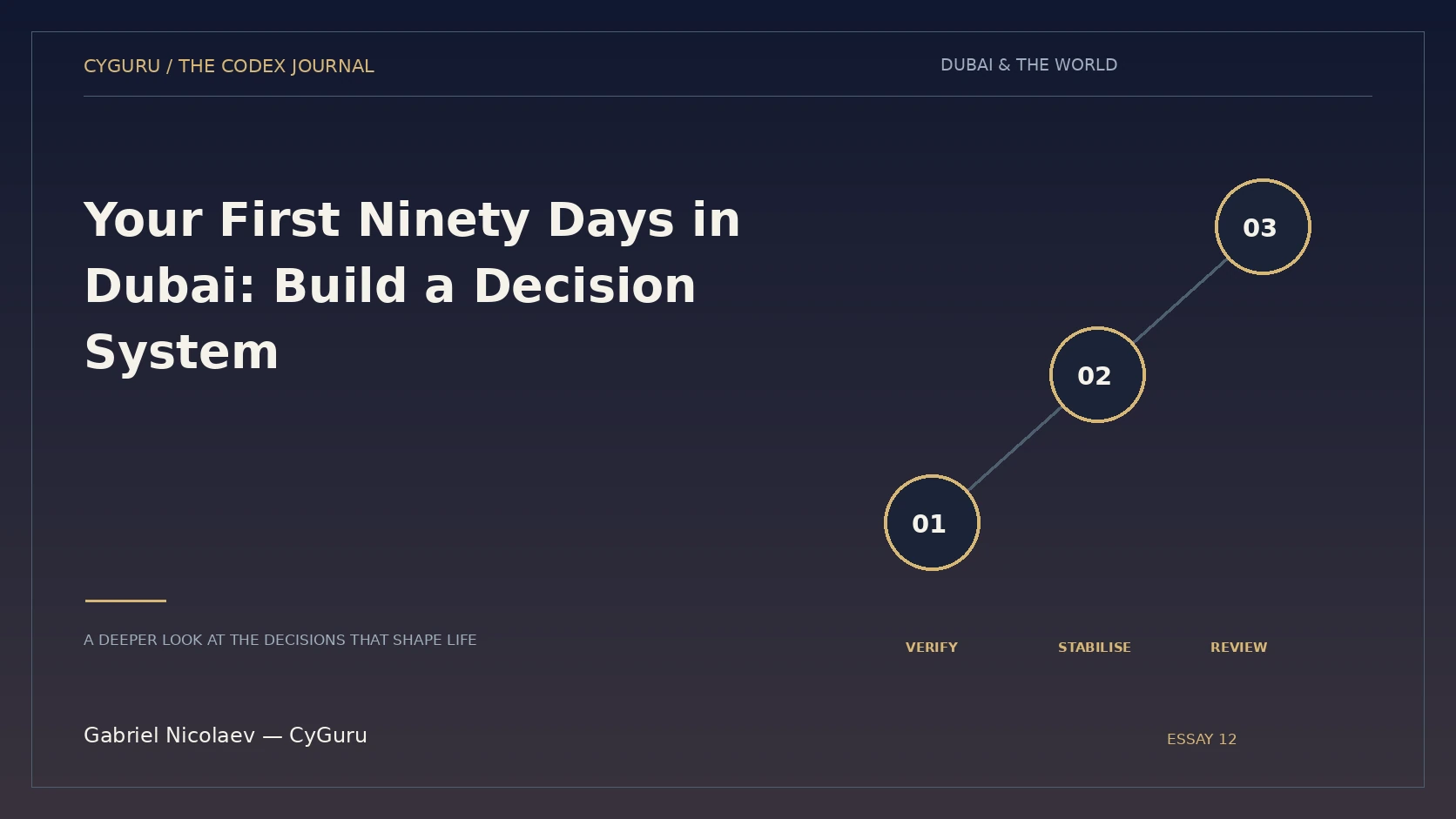
Treat the first ninety days as a learning period with decisions attached, rather than a deadline to look fully settled. The number is a planning horizon, not an official rule or a guarantee that every process will be complete. Its value is to create stages in which information can change your choices before those choices become expensive to reverse.
Days one to thirty: establish what must be verified
Create a single register of practical questions. Separate the requirements that depend on your personal status, employment or business activity from general advice heard in conversation. Record the official source, the relevant institution and the next action. A confident anecdote can suggest a question to investigate; it should not automatically become the rule governing your situation.
At the same time, measure actual outgoings rather than relying entirely on an imagined monthly lifestyle. Temporary accommodation, transport and setup expenses can differ from the later pattern. Label one-off costs and continuing costs separately. The purpose is not to judge the move prematurely. It is to discover how much cash and attention the transition is consuming.
Days thirty-one to sixty: test the working assumptions
If you moved for work or business, identify the evidence that supports the plan. For an employee, this may concern the actual role, commuting demands and the terms of the employment arrangement. For a founder, it may concern customer conversations, delivery capacity and a verified licensing path. The relevant test depends on the reason for being there.
For business establishment, Dubai’s official guidance describes different setup options and licensing considerations. Check those requirements for your intended activity rather than copying another founder’s arrangement. Then keep the commercial test separate: what has a customer committed to, and what remains an encouraging conversation? Administrative progress and market progress need different records.
Delay the commitments whose value depends on missing information
Not every decision can wait. Some commitments are necessary to function. Others mainly create the feeling of arrival: a large office, an unnecessarily expensive annual contract or a lifestyle chosen before the location of work is clear. Where practical, preserve flexibility until you know which commitments support the life or business you are actually building.
Imagine a hypothetical newcomer selecting accommodation principally for its image, then discovering that the daily travel burden undermines work and family time. The initial decision solved an identity problem more quickly than an operational one. A short period of observation might have changed the priorities. Reversibility can be valuable precisely because the first version of the plan is incomplete.
Days sixty-one to ninety: review rather than rationalise
Review three groups of evidence: practical stability, financial sustainability and progress toward the reason for moving. Which documents or arrangements remain unresolved? How do actual costs compare with the plan? What results support continuing, narrowing or changing direction? An honest review can preserve ambition while altering the method used to pursue it.
Decide in advance what would trigger a change. If no threshold exists, every disappointment can be explained as a reason to spend more time and money. Equally, a difficult week should not automatically overturn a promising plan. Use scheduled review points so that neither a stimulating evening nor a discouraging morning becomes the sole authority over the decision.
Arrive operationally before performing arrival socially
A stable beginning may look ordinary: accurate records, manageable travel, reliable communication, understood obligations and a small number of useful relationships. These do not photograph like a dramatic reinvention. They provide the foundation on which a more ambitious chapter can be built without constant emergency.
Write a one-page ninety-day plan with three columns: what must be verified, what will be tested and what will be reviewed before further commitment. Put a source or an owner beside each item. The first months become more productive when you use them to improve your map, rather than forcing reality to confirm the map you arrived with.
Read the connected perspective
Continue this question with Building in Dubai: Can the Business Work Without You?. From the existing archive, How to Start a Company in Dubai and Legally Reduce Your European Tax Burden offers another part of the discussion.
Sources and editorial perspective
The official references below support the specific financial or administrative points identified in the text. The scenarios are hypothetical; the wider interpretation and review questions are the author’s.
References checked on 5 November 2026.