THE CODEX JOURNAL
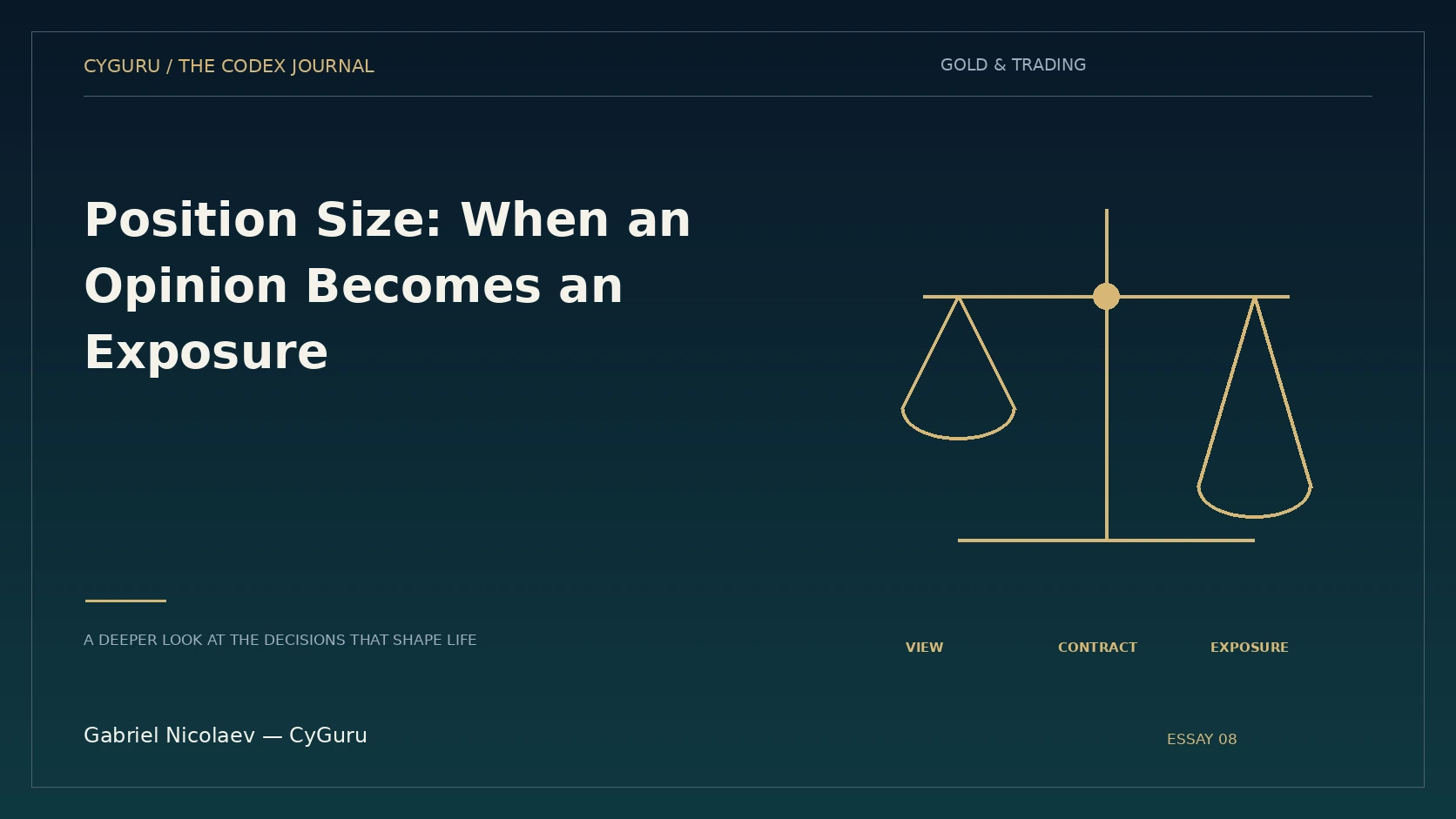
Position Size: When an Opinion Becomes an Exposure
Reading tools & contents
A market view does not tell you what you can carry
“I think gold will rise” is an opinion about direction. It says nothing yet about instrument, entry, time horizon, contract value or the conditions under which the idea should be abandoned. A person can have a reasonable directional argument and still take exposure that makes ordinary variation financially or behaviourally unmanageable.
This is where analysis becomes a transaction. The view must be translated into a product with actual terms and a position with actual consequences. Confidence is only one input, and often a difficult one to calibrate. It should not quietly replace the work of understanding what the position can lose and whether that loss is affordable.
Understand the unit before trusting the number
The same movement in a quoted price can have different financial effects across products, contract sizes and account currencies. A position displayed as a small decimal quantity is not necessarily a small exposure. Before trading, verify the broker’s contract specification, value per price movement, margin terms and relevant charges for that exact instrument.
Use a hypothetical example only to understand the arithmetic: if an instrument’s verified value is V per unit of price movement, quantity is Q and the distance to planned invalidation is D, the simple planned price risk is V × Q × D. This is not the full potential loss. Costs, slippage, gaps, conversion and product terms can change the result.
Invalidation belongs to the idea, not the desired quantity
A common reversal occurs when a trader chooses an attractive position size and then moves the exit closer to make the risk calculation look acceptable. The location is no longer based on what would invalidate the setup. It is based on fitting the quantity the trader already wants. Arithmetic has become a justification for a prior emotional choice.
Describe the idea’s invalidation independently. Then calculate what exposure, if any, fits the financial limit and product constraints. If the minimum tradable quantity is too large, or the conditions are too uncertain to define, there may be no suitable transaction. An analysis does not create an obligation to place an order.
Financial capacity and emotional tolerance are related but distinct
A position can be affordable in account terms yet dominate attention, sleep and judgment. Conversely, a person may feel calm while carrying a financially unsuitable risk. Neither feeling settles the question alone. Review available capital, other obligations, correlated exposures and the consequences of an adverse sequence alongside your observed behaviour under pressure.
Watch what happens after entry. Are you repeatedly checking when no decision is required? Moving the invalidation to avoid accepting a loss? Unable to follow the timeframe you selected? These observations can identify a mismatch between the planned process and the exposure you actually carried. They are reasons for review, not proof of a particular medical condition.
Margin is not a complete statement of risk
Investor.gov explains that leveraged strategies can produce substantial losses, including losses beyond the initial investment in some arrangements. A margin requirement describes a condition for carrying a position; it should not be mistaken for a universal ceiling on what can be lost. Protections and obligations depend on the product, provider and applicable terms.
Read those terms before deciding that a small deposit makes the trade small. Check what can trigger liquidation and how orders may execute during rapid movement. If you cannot explain the contract’s risk in ordinary language, increasing confidence in the market view is not the missing step. Understanding the exposure is.
Write the consequence before placing the order
A pre-entry note should identify the instrument, verified unit value, quantity, invalidation, planned loss estimate, execution limitations and reason for taking the trade. It should also state what would cause you to stop initiating new positions. That note connects analysis to an operational decision rather than leaving the connection to be invented after price moves.
Review one recent position using this sequence. Where did a verified number end and an assumption begin? Which part would have changed if your conviction had been weaker? The purpose of sizing is to make uncertainty carryable, not to make conviction look impressive. If no suitable size exists, the appropriate result of the analysis can be no trade.
Read the connected perspective
Continue this question with The Trading Journal That Records Decisions, Not Excuses. From the existing archive, Stress Tolerance Creates Wealth offers another part of the discussion.
Sources and editorial perspective
The official references below support the specific financial or administrative points identified in the text. The scenarios are hypothetical; the wider interpretation and review questions are the author’s.
References checked on 5 November 2026.