CYGURU
THE GOLD NERVOUS SYSTEM INDICATOR
THE GOLD NERVOUS SYSTEM INDICATOR
The Neuroscience of Fear, Greed, Panic and Decision-Making in XAU/USD Trading
By Gabriel Nicolaev – CyGuru
The Hidden Human Science Behind Gold Trading
Every gold trade is a financial decision. Every financial decision is also a neurological event.
Why do experienced traders panic when gold moves against their positions? Why do investors abandon carefully constructed strategies during periods of extreme volatility? Why do some traders close profitable positions too early, hold losing positions too long, or enter the market impulsively after breaking financial news?
The answers extend far beyond technical analysis.
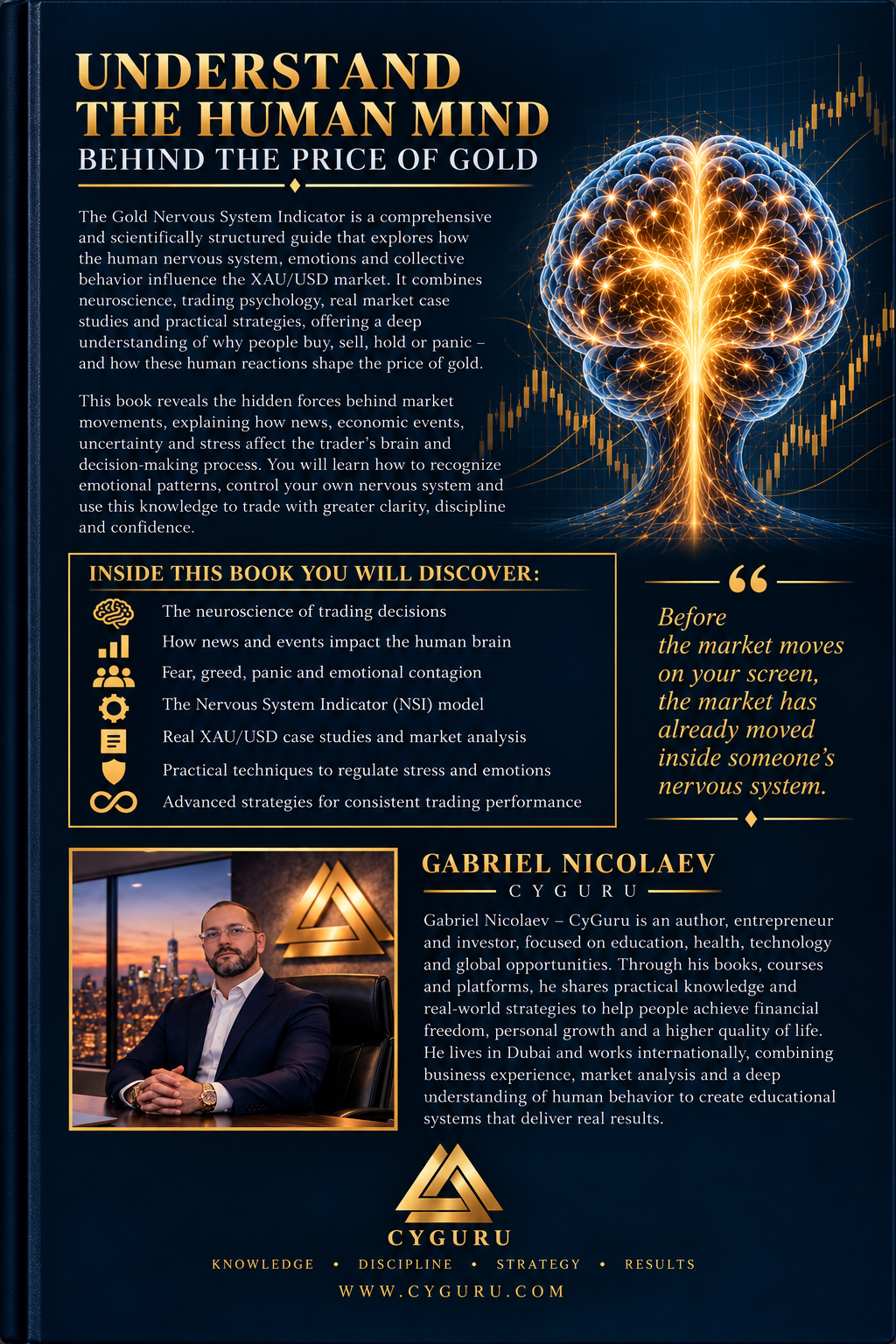
The Gold Nervous System Indicator explores the biological, psychological and behavioral mechanisms that influence how people perceive financial risk, respond to uncertainty and make decisions in the global gold market.
Written by Gabriel Nicolaev – CyGuru, this comprehensive scientific treatise connects human neuroanatomy, neurophysiology, behavioral finance, decision science and XAU/USD trading psychology.
Its central subject is the relationship between the human nervous system and financial decision-making, from the activity of individual neural networks to the behavioral dynamics of market participants.
Where Neuroscience Meets the Gold Market
Traditional trading education focuses on candlestick patterns, indicators, market structure, macroeconomic data and price movements.
This book investigates another dimension: the biological and psychological processes influencing the people who interpret that information and act upon it.
Explore how the brain processes financial uncertainty, how emotional learning affects risk perception and how physiological stress can influence the execution of trading strategies.
Discover the roles of the prefrontal cortex, amygdala, insula, hippocampus, basal ganglia and autonomic nervous system in attention, memory, valuation, motivation and behavioral regulation.
Understand why the same XAU/USD chart can produce entirely different decisions in different traders.
The Neuroscience of BUY, SELL, HOLD and Panic
Behind every trading action lies a complex interaction of expectations, memories, incentives and perceived consequences.
This treatise examines the mechanisms associated with:
- Fear of financial loss and panic selling
- Greed, reward anticipation and excessive risk-taking
- FOMO and impulsive market entries
- Revenge trading after consecutive losses
- Premature exits from profitable positions
- Holding losing trades beyond predefined risk limits
- Emotional responses to stop-loss execution
- Decision fatigue, cognitive overload and stress
- Overconfidence following profitable trades
- Trading discipline, inhibitory control and psychological recovery
Rather than reducing trading psychology to motivational advice, the book examines the scientific foundations of these behaviors and their practical implications.
Gold Trading Psychology During Major Economic Events
Gold is closely connected to global monetary conditions, real interest rates, the US dollar, investment flows and geopolitical uncertainty.
Major announcements can produce rapid changes in expectations, liquidity and volatility.
The Gold Nervous System Indicator explores how traders process uncertainty surrounding:
- Federal Reserve and FOMC announcements
- US Consumer Price Index (CPI) reports
- Nonfarm Payrolls (NFP) releases
- Interest rate decisions and monetary policy
- Geopolitical conflicts and safe-haven demand
- Unexpected economic developments
- Sudden gold-price breakouts and reversals
The analysis distinguishes between the economic forces influencing gold prices and the psychological responses of individuals participating in the market.
Introducing the Nervous System Indicator — NSI
At the center of this work is the Nervous System Indicator (NSI), a proposed scientific framework for examining the relationship between physiological state, emotional responses, cognitive control and trading behavior.
The model investigates six interconnected dimensions:
Threat Response — How perceived financial danger influences attention, stress and defensive behavior.
Reward Activation — How profit anticipation, motivation and reinforcement learning affect financial decisions.
Cognitive Control — How traders maintain rules, evaluate alternatives and regulate impulsive actions.
Emotional Contagion — How social information and collective behavior may influence market participants.
News Reactivity — How unexpected information and scheduled economic events affect attention and decision-making.
Recovery Capacity — How traders respond to adverse outcomes and regain effective decision-making capacity.
The NSI is developed as a research-oriented framework, with attention to measurement, reliability, scientific validation and the limitations of behavioral prediction. It is not presented as a proven standalone indicator of future gold prices.
A Scientific Encyclopedia of the Human Trading Mind
Designed as an advanced interdisciplinary reference, the book examines:
-
Human nervous system anatomy and physiology
-
Neural communication and neurotransmitters
-
Emotional learning and financial risk perception
-
Neuroeconomics and behavioral finance
-
Cognitive biases and decision-making under uncertainty
-
Autonomic regulation and physiological stress
-
Market sentiment and collective behavior
-
The psychology of gold-market volatility
-
Physiological and behavioral measurement methods
-
Professional trading discipline and risk management
-
Neuroscience-informed approaches to decision review
-
The future of AI, neurofinance and behavioral market research
Scientific illustrations, explanatory models and XAU/USD case studies connect theoretical knowledge with the practical realities of financial markets.
Who Should Read This Book?
Gold and XAU/USD Traders: Understand the psychological mechanisms that can interfere with trading discipline, execution and risk management.
Professional and Institutional Traders: Explore the scientific foundations of financial decision-making under uncertainty.
Investors and Portfolio Managers: Examine how behavioral tendencies influence financial risk assessment and investment choices.
Psychologists and Neuroscience Enthusiasts: Discover applications of cognitive neuroscience, stress physiology and behavioral research in financial environments.
Financial Educators and Researchers: Investigate an interdisciplinary framework connecting human biology with market participation.
Beyond Technical Indicators
A moving average measures historical price behavior. A volatility indicator describes market fluctuations. An economic calendar identifies scheduled information releases.
The Nervous System Indicator asks a different question:
What happens inside the human decision-maker when uncertainty, opportunity and financial consequences converge?
Understanding that question may improve the study of trading behavior, psychological resilience and decision processes.
The Gold Nervous System Indicator offers a scientific perspective on the relationship between the human brain and the gold market.
Because understanding the market also requires understanding the human beings who participate in it.
THE GOLD NERVOUS SYSTEM INDICATOR
The Neuroscience of Fear, Greed, Panic and Decision-Making in XAU/USD Trading
Gabriel Nicolaev – CyGuru
Knowledge. Discipline. Strategy. Evolution.
Educational and scientific content only. This book does not provide personalized investment advice, guarantee trading performance or claim that neurological measurements can reliably predict gold-price direction.
Share