CYGURU
RAK - RAS AL KHAIMAH: THE BLUEPRINT OF THE FUTURE
RAK - RAS AL KHAIMAH: THE BLUEPRINT OF THE FUTURE
The System Behind Vision, Growth, and Global Influence
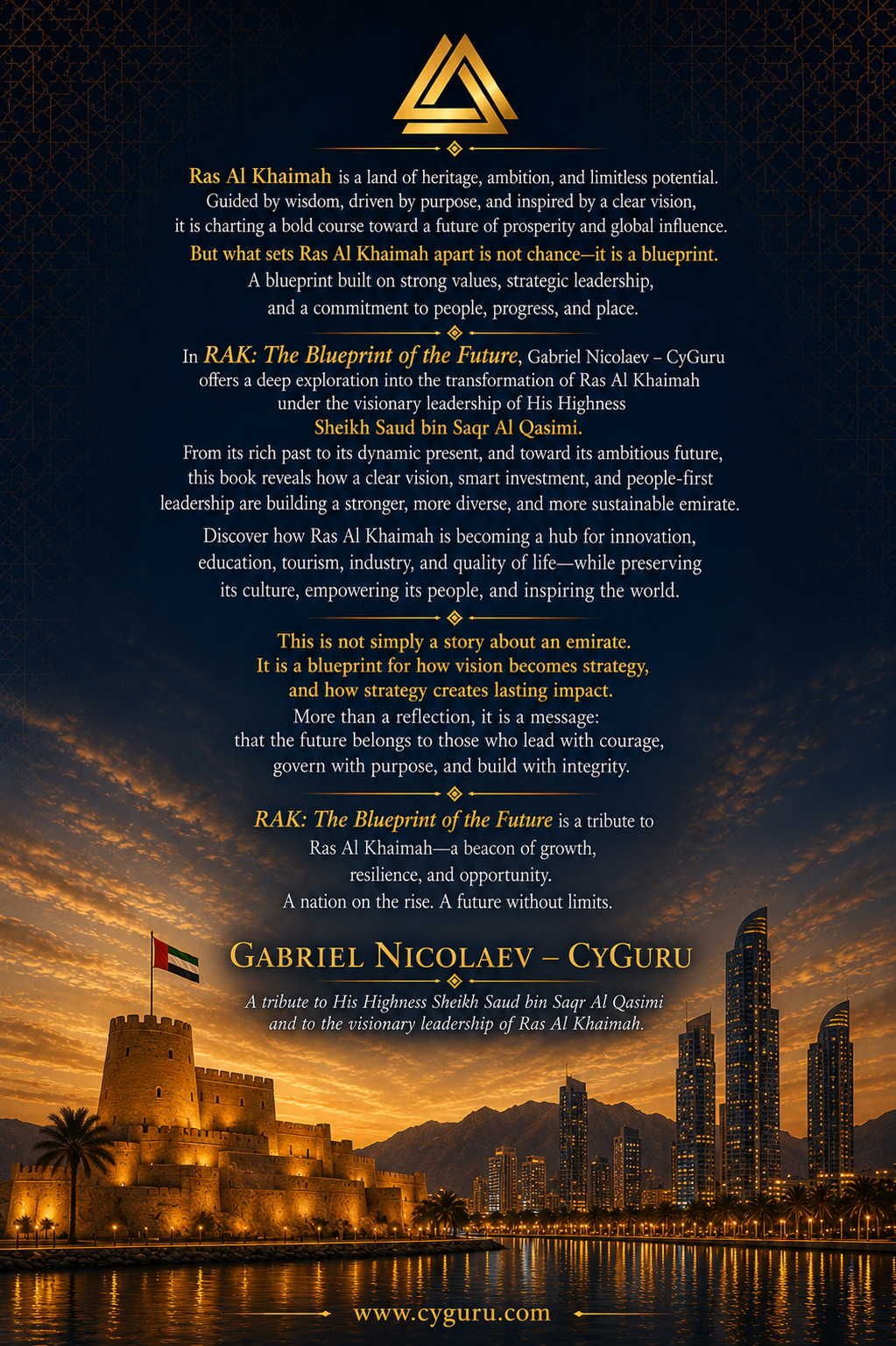
A tribute to His Highness Sheikh Saud bin Saqr Al Qasimi and to the visionary leadership of Ras Al Khaimah.
Some places grow.
Others are deliberately built for the future.
Ras Al Khaimah is becoming one of them.
In RAK — Ras Al Khaimah: The Blueprint of the Future, Gabriel Nicolaev — CyGuru goes beyond conventional descriptions of the United Arab Emirates to examine the deeper system behind the transformation of Ras Al Khaimah: leadership, stability, strategic thinking, identity, investment, education, infrastructure, tourism, industry, human capital, and the discipline required to transform vision into lasting progress.
This is not a travel book.
It is not simply a history of an Emirate.
It is a study of how civilizations are built.
At the center of the book stands Ras Al Khaimah — an Emirate whose character was forged between mountain and sea, heritage and ambition, resilience and opportunity. Under the leadership of His Highness Sheikh Saud bin Saqr Al Qasimi, RAK has developed an increasingly distinctive position within the United Arab Emirates: modern without abandoning identity, internationally connected without losing its roots, ambitious without needing to imitate the noise of larger global cities.
Gabriel Nicolaev examines this transformation through the larger architecture of the UAE itself.
Abu Dhabi represents sovereign stability and long-term institutional thinking.
Dubai demonstrates the extraordinary power of ambition, global connectivity, business, branding, and execution.
Sharjah protects intellectual depth, education, culture, and Arab identity.
The Northern Emirates complete a federation whose strength comes not from uniformity, but from complementary identities operating within a common national vision.
Within this ecosystem, Ras Al Khaimah is emerging with a character of its own.
Its mountains, coastline, ports, industrial base, tourism economy, expanding hospitality sector, international investment, real estate development, education, infrastructure, and strategic location are converging at an important moment in its history.
But The Blueprint of the Future goes deeper than development.
The book asks questions that concern every nation.
Why do some societies transform vision into reality while others remain trapped in short-term thinking?
Why does stability create prosperity?
What happens when leadership thinks in generations rather than moments?
How can a nation modernize without losing its identity?
Why are education and human capital more important to long-term power than temporary wealth?
What separates genuine development from construction alone?
And what kind of civilization will remain strong in a century shaped by artificial intelligence, geopolitical uncertainty, technological acceleration, demographic transformation, and unprecedented pressure on human attention?
Through these questions emerges a larger philosophy:
Vision without execution remains imagination.
Growth without stability becomes fragile.
Wealth without identity becomes empty.
Leadership without continuity cannot build civilization.
The future requires all of them.
Drawing also from his personal experience living in the United Arab Emirates, Gabriel Nicolaev approaches the country not simply as an external observer, but as someone fascinated by the psychological architecture beneath its success — the relationship between leadership and trust, safety and ambition, stability and investment, identity and modernization.
Ras Al Khaimah becomes the central case study through which a larger principle is revealed.
Great nations are not accidents.
They are systems.
They are created when leadership gives direction to ambition, when institutions transform direction into continuity, when education prepares the next generation, when identity survives prosperity, and when people are given enough stability to imagine a future greater than survival.
The final chapters move beyond Ras Al Khaimah toward an even larger question: what can the rise of the UAE teach us about the future of civilization itself?
In a world becoming louder, faster, more fragmented, and increasingly unstable, Ras Al Khaimah represents another possibility — development with proportion, ambition with identity, internationalization with continuity, and growth anchored in a landscape and culture that still remember where they came from.
Perhaps the most powerful transformations do not begin with noise.
Perhaps they begin quietly, when vision becomes strategy, strategy becomes systems, and systems become reality.
RAK — Ras Al Khaimah: The Blueprint of the Future is ultimately a book about much more than an Emirate.
It is about leadership.
It is about civilization.
It is about legacy.
And it is about the people who understand that the future is not something we wait for.
The future is something we build.
Gabriel Nicolaev — CyGuru
Share