 GABRIEL NICOLAEV — CYGURU
Money & Leadership
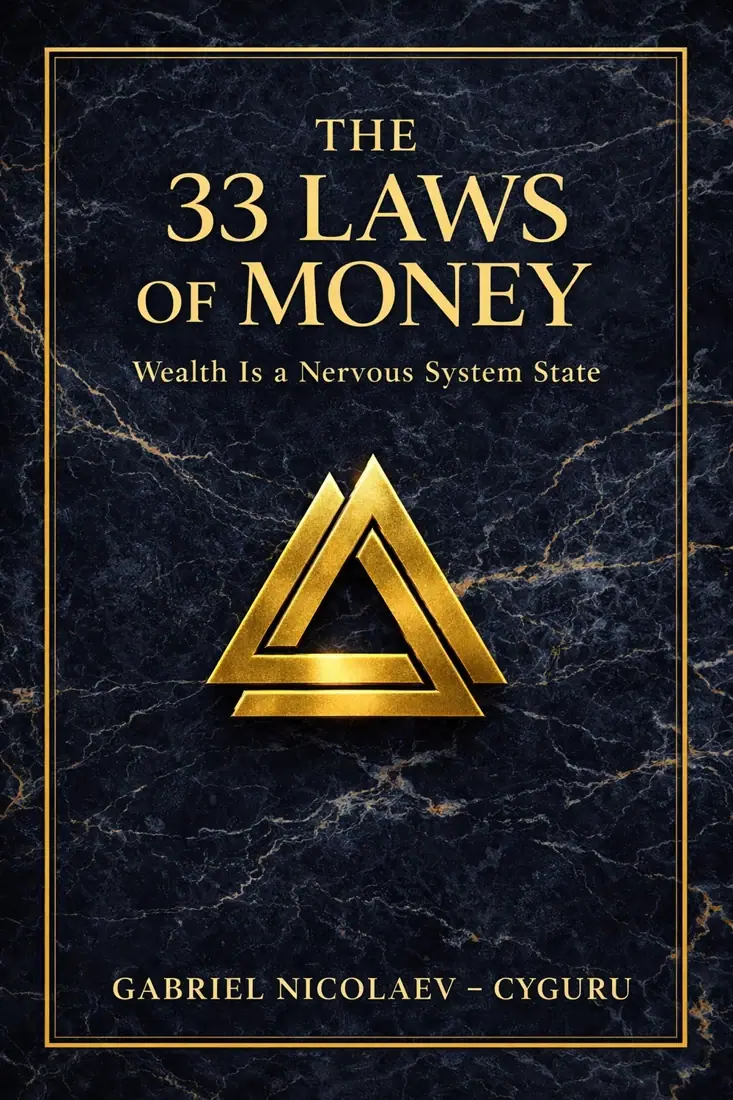
The 33 Laws of Money
For centuries, wealth has been treated as a financial outcome — a result of strategy, intelligence, or luck. Yet history repeatedly shows that money does not remain where structure does not exist. Capital does not stay inside instability. It does not settle in chaos. It does not trust the emotionally reactive.
Who this book is for
Readers who prefer a concentrated, principle-led reflection on money, discipline and their response to financial pressure.
What you will explore
- Thirty-three principles presented through the author's regulation framework
- Identity, environment and emotional reactivity around money
- The distinction the book draws between ambition and durable structure
Why begin here
Choose this volume for its philosophical approach to financial behaviour. Its organising form is a set of laws to examine and revisit; readers seeking a step-by-step investment or budgeting workbook should assess that difference before choosing.
A question to take into the book
What structure supports my financial decisions when motivation disappears?
Reading tools & contents
Book excerpt
The paradox of wealth is that the behaviors that feel exciting rarely sustain it. The behaviors that sustain it often feel uneventful. Discipline is repetitive. Investment review is methodical. Risk evaluation is analytical. Patience is uneventful. Dopamine seeks intensity; compounding thrives in steadiness.
Book excerpt
Ownership also requires humility. Markets can move against your expectations. Businesses encounter unforeseen resistance. Conditions shift. If ego prevents recalibration, loss magnifies. Emotional maturity allows admission of miscalculation without identity collapse. Correction becomes adaptation rather than humiliation.
Wealth Is a Nervous System State
Money is not a number. It is a biological state.
For centuries, wealth has been treated as a financial outcome — a result of strategy, intelligence, or luck. Yet history repeatedly shows that money does not remain where structure does not exist. Capital does not stay inside instability. It does not settle in chaos. It does not trust the emotionally reactive.
In The 33 Laws of Money, Gabriel Nicolaev – CyGuru dismantles the surface understanding of wealth and rebuilds it from the inside out. This is not a finance manual. It is a structural doctrine. It examines money as a function of nervous system regulation, identity calibration, environmental influence, discipline, and pressure tolerance.
Each of the thirty-three laws reveals a deeper layer of financial reality:
- Why scarcity is a stress response.
- Why cortisol destroys capital.
- Why dopamine sabotages compounding.
- Why debt exposes structural instability.
- Why environment determines income.
- Why wealth requires detachment.
- Why structure, not ambition, creates fortune.
Drawing from lived experience under extreme financial pressure, transformation in high-intensity environments, and years of studying biological and structural systems, CyGuru presents wealth not as something to chase, but as something to stabilize.
This book is for those who understand that: Income is temporary. Structure is permanent. Money responds to regulation.
Written in dense, philosophical, disciplined prose, this flagship volume belongs beside the most serious works on power, order, and human systems. It does not offer shortcuts. It offers structural recalibration.
If you seek strategies, this is not your book. If you seek structural mastery, it is. Because money does not respond to desire. It responds to structure.
EXPLORE BEFORE YOU CHOOSE
Ideas beyond the cover.


EXPLORE THE QUESTION
Read alongside this book
The Business That Pays You Only When You Ignore Your Own Hours
Examine a business that appears rewarding only while its owner’s labour stays invisible, and separate building an asset from endlessly supplying unpaid capacity.
Read the essay ↗A Share of the Revenue Is Not a Complete Account of Contribution
Explore the work, resources and continuing responsibilities that a revenue split can conceal, and how collaborators can discuss contribution without a personal scoreboard.
Read the essay ↗EXPLORE THE QUESTION
Read alongside this book
READ ALONGSIDE THIS BOOK
Questions to take further
CONTINUE YOUR DISCOVERY