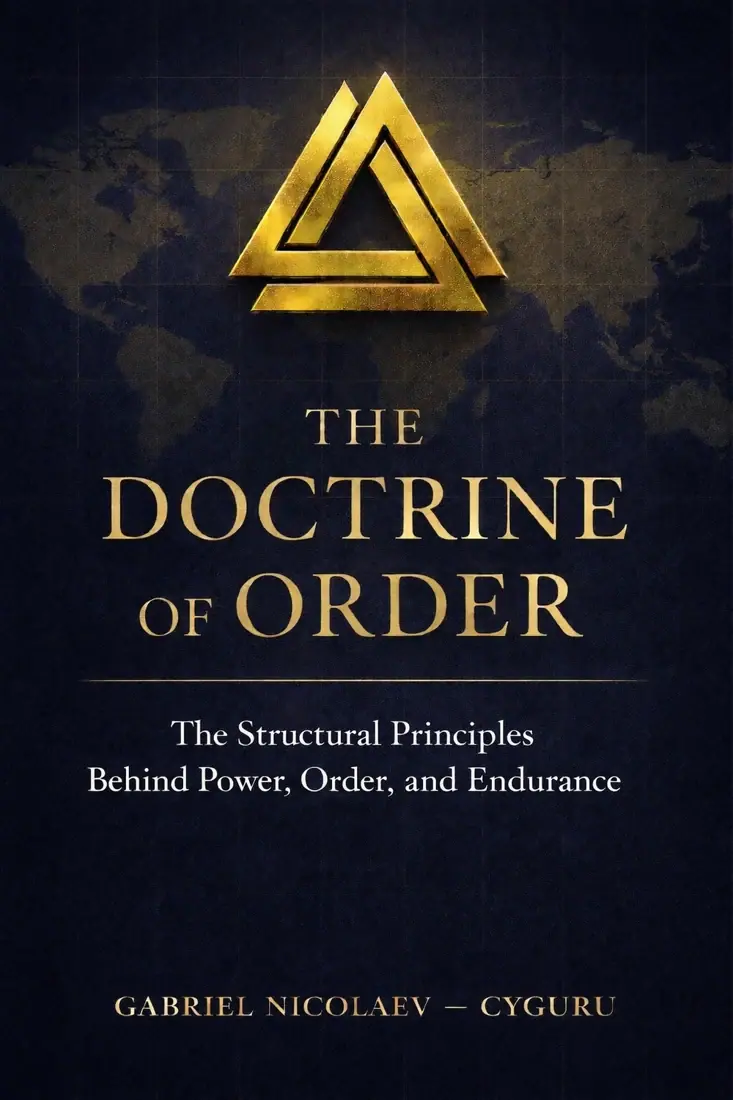
 GABRIEL NICOLAEV — CYGURU
The Human Codes
The Doctrine of Order
Empires fall not because they lack passion — but because they lack structure. Leaders collapse not because they lack vision — but because they lack internal order. Systems decay not from weakness — but from instability.
Who this book is for
Leaders, organisers and readers thinking about the durability of personal, organisational or institutional systems.
What you will explore
- The author's distinction between authority and control
- Internal order, adaptation and responses to pressure
- The relationship he proposes between structure and endurance
Why begin here
Choose this title when the construction of a durable system is your central interest. It develops the author's argument about foundations and governance, while The Final Human Error approaches related questions through the lens of breakdown and decay.
A question to take into the book
What keeps a system dependable when the enthusiasm or presence of its founder is absent?
Reading tools & contents
The Structural Principles Behind Power, Order and Endurance
Order is the hidden architecture behind all lasting power.
Empires fall not because they lack passion — but because they lack structure. Leaders collapse not because they lack vision — but because they lack internal order. Systems decay not from weakness — but from instability.
In The Doctrine of Order, Gabriel Nicolaev – CyGuru presents a structural framework that dismantles the emotional myths surrounding power, governance, endurance, and control.
This is not a philosophical reflection. It is a structural manual. Drawing from nervous system regulation, institutional durability, civilizational patterns, and psychological architecture, Nicolaev reveals the underlying principles that determine whether a system:
- collapses under pressure
- absorbs shock
- adapts
- or becomes unbreakable
This book explains why chaos seduces — and why structure prevails. Why emotional governance fails — and structural governance endures. Why dominance is temporary — but order is permanent.
You will learn:
- The structural difference between authority and control
- Why stability creates freedom
- Why most systems decay from internal disorder
- How to build durable frameworks — personal, institutional, geopolitical
- Why resilience is engineered, not wished into existence
This is a doctrine for builders. For leaders. For architects of systems. For those who understand that endurance is not accidental. Power without structure burns out. Structure without emotion survives. Order built correctly becomes inevitable. This is not about control. It is about foundation.
EXPLORE BEFORE YOU CHOOSE
Ideas beyond the cover.


EXPLORE THE QUESTION
Read alongside this book
EXPLORE THE QUESTION
Read alongside this book
CONTINUE YOUR DISCOVERY