CYGURU
THE WAR AGAINST THE FUTURE
THE WAR AGAINST THE FUTURE
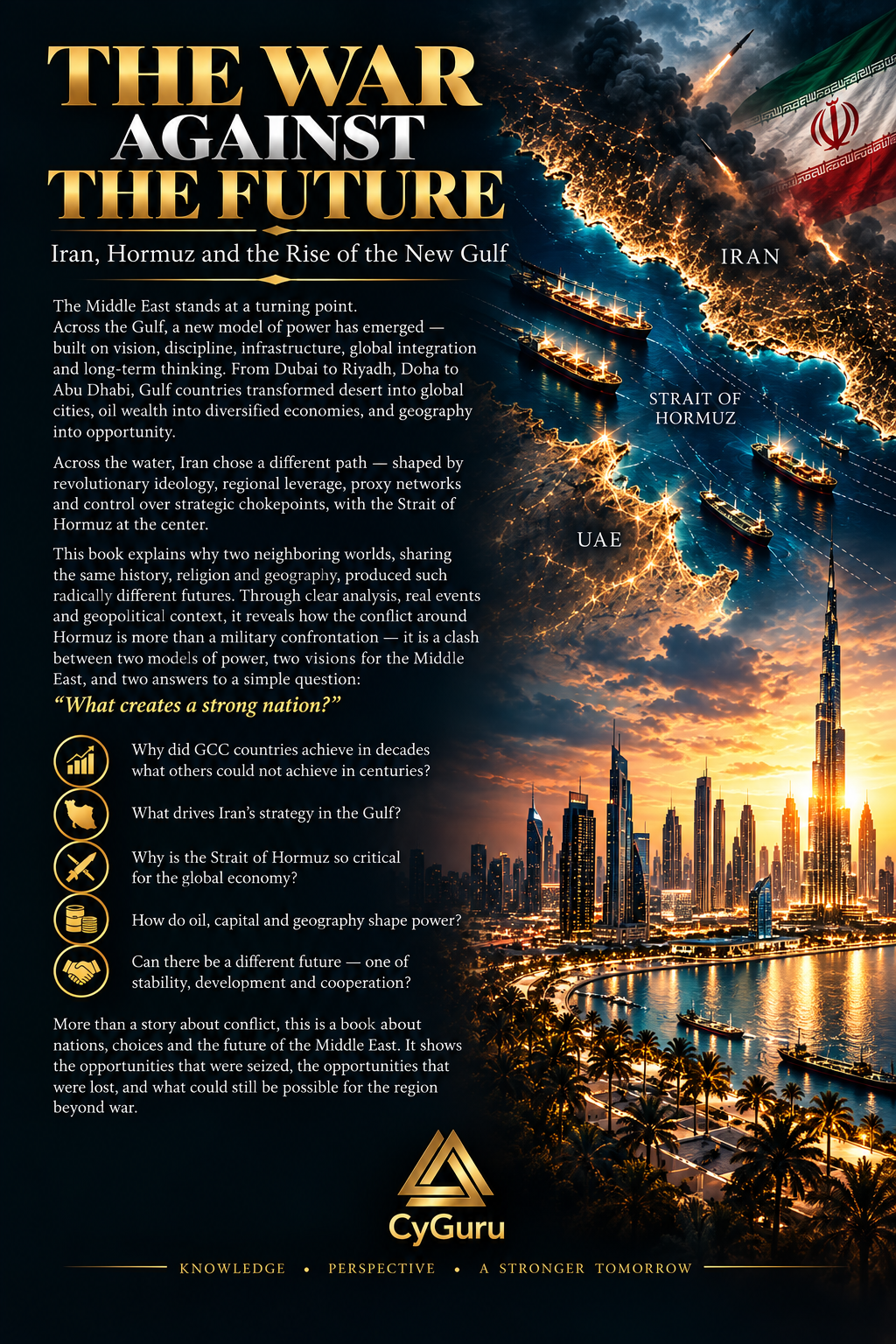
Iran, Hormuz and the Rise of the New Gulf
The War Against the Future is a geopolitical study of one of the most consequential transformations taking place in the modern Middle East: the growing divergence between Iran and the Gulf states across the narrow waters of the Strait of Hormuz. On one shore stands Iran, an ancient civilization with enormous energy resources, a large population, strategic geography, industrial experience and considerable human talent, but also a state whose modern trajectory has been profoundly shaped by the 1979 Revolution, the Iran-Iraq War, sanctions, isolation, military pressure and an increasingly sophisticated security architecture built around deterrence and survival. Across the water, Saudi Arabia, the United Arab Emirates, Qatar, Kuwait, Oman and Bahrain have followed a different path, converting hydrocarbon wealth into sovereign capital, infrastructure, ports, airports, global airlines, logistics networks, financial centers, tourism, technology and increasingly ambitious post-oil economies. The geographical distance between these two worlds is small. The strategic distance has become enormous.
Gabriel Nicolaev approaches this divide not simply as a conflict between Iran and the Gulf, but as a much larger question about the nature of national power. What actually makes a country powerful in the twenty-first century? Is power measured by missiles, territory, population and the ability to inflict destruction, or by something deeper: the capacity to convert resources into infrastructure, capital into knowledge, knowledge into technology, stability into investment and human intelligence into capabilities that continue compounding across generations? Through 64 chapters, the book follows this question from pre-revolutionary Iran and the rupture of 1979 through the Iran-Iraq War, the rise of the Islamic Revolutionary Guard Corps, sanctions, missiles, drones, proxy networks and asymmetric warfare, before crossing the Gulf to examine Dubai, Abu Dhabi, Saudi Arabia's transformation, Qatar's global reach, sovereign wealth funds, aviation, ports, energy, artificial intelligence, advanced industry and the emerging economic architecture of the GCC.
The analysis does not deny the strategic logic behind Iran's security doctrine. Iran learned from war and isolation that it could not compete symmetrically with militarily and economically stronger adversaries, and it therefore developed ways of making conventional superiority expensive: missiles, drones, maritime pressure, strategic depth and relationships with armed organizations across the region. This produced genuine resilience. Iran demonstrated that a state under enormous external pressure could survive, adapt and preserve strategic agency. But The War Against the Future asks the harder question that follows: what is the long-term opportunity cost of becoming exceptionally capable at surviving confrontation? A state can become difficult to defeat while still failing to realize much of its economic potential. It can master the technologies of resistance while losing scientists, entrepreneurs, investment, technological access and decades of compounding economic opportunity. Iran's deepest strategic problem may therefore not be military defeat at all. It may be time.
This becomes especially important because the countries across the Gulf are not standing still. Saudi Arabia is attempting one of the largest economic transformations in its modern history. The UAE has become an international center for capital, aviation, logistics and increasingly advanced technology and artificial intelligence. Qatar has converted gas wealth into sovereign capital and global networks. Oman possesses geography of exceptional strategic importance beyond the narrowest dependence on Hormuz. Kuwait controls immense accumulated financial assets, while Bahrain retains a significant position in regional finance and services. Iran can therefore improve economically and still lose relative position if its neighbors accumulate capability more rapidly. The gap is not static. It compounds.
The book applies the same analytical discipline to the GCC. Gulf prosperity is not treated as proof that every strategic problem has been solved, nor is its transformation explained simply by "oil money." Hydrocarbons created financial possibility, but resources do not determine what societies ultimately become. Money can be consumed, wasted or converted into productive systems. The strategic achievement of the modern Gulf has been its increasing ability to perform that conversion: energy into capital, capital into infrastructure, infrastructure into connectivity, connectivity into talent, talent into knowledge, and knowledge into capability. Yet the next stage will be considerably harder. Purchasing technology is not the same as understanding it. Importing exceptional scientists is not the same as creating a research ecosystem. Buying sophisticated defense systems is not the same as possessing the engineering depth required to develop them. The Gulf has already demonstrated that capital can transform physical geography. Its next challenge is to transform intellectual geography.
At the center of this confrontation lies the Strait of Hormuz, where energy, geography, military power and global economic dependence converge. Nicolaev moves beyond the conventional question of whether Iran could disrupt the Strait and asks something strategically more important: how can the value of disruption itself be reduced? Alternative energy routes, interconnected electricity systems, strategic inventories, cyber resilience, maritime security, integrated air defense, distributed infrastructure and rapid reconstruction can change the relationship between an attack and its political consequences. An adversary may succeed in damaging an asset without succeeding in destabilizing the system behind it. From this emerges one of the book's central principles: the objective is not only to make aggression expensive; it is to make aggression ineffective.
This idea expands the meaning of defense itself. Ports, electricity grids, desalination systems, data centers, logistics networks, financial reserves and alternative energy routes are not merely economic infrastructure. Under conditions of conflict they become components of national security. Redundancy may appear inefficient during perfect conditions, but during crisis redundancy becomes sovereignty. The strongest system is therefore not necessarily the one in which nothing can be destroyed—such a system does not exist—but the one in which destroying individual components does not produce systemic collapse.
The analysis eventually moves beyond Iran and asks what the GCC itself could become. Nicolaev argues that Saudi Arabia, the UAE, Qatar, Kuwait, Oman and Bahrain possess complementary capabilities whose combined strategic value could exceed the sum of their individual strengths. Saudi scale, Emirati connectivity and capital, Qatari gas and international networks, Omani geography, Kuwaiti accumulated wealth and Bahraini financial experience do not require political unification to become more powerful together. What is required is greater strategic interoperability: infrastructure capable of supporting alternative routes, interconnected systems, deeper economic integration, coordinated security and a regional architecture capable of functioning under pressure. Six sovereign states can remain six sovereign states while increasingly operating as one strategic system where common interests require it.
The book also rejects the idea that the Gulf's future should be reduced to choosing between Washington and Beijing. American security relationships, Chinese commerce and manufacturing, India's growing economic and demographic gravity, European technology and markets, and Africa's future growth create a much larger field of opportunity. Strategic autonomy does not necessarily mean having fewer external relationships. It can mean having enough relationships that no single one becomes capable of controlling the future. This leads to one of the deeper ideas developed throughout the book: modern sovereignty is increasingly a function of optionality. A powerful state possesses alternatives. One route can fail without isolating the economy. One supplier can disappear without eliminating technological access. One strategic partner can change policy without determining national survival. One industry can decline without taking the entire economic system with it.
These ideas culminate in The Nicolaev Doctrine, the original strategic framework developed in the final part of the book. Its foundational proposition is simple but changes the measurement of power: Power is not the amount of destruction a state can produce. Power is the amount of reality it can continue controlling after disruption. A truly powerful state continues producing electricity after infrastructure is attacked, keeps ports functioning when routes are threatened, preserves financial confidence during crisis, protects digital systems, reconstructs damaged assets rapidly, maintains diplomatic alternatives when alliances shift and continues creating wealth when the economic environment changes. Power is therefore not merely destructive capacity. It is continuity, adaptability and the preservation of choices.
From this perspective, capital becomes strategic when it creates options. Infrastructure becomes deterrence when its redundancy makes attack less useful. Talent becomes territory because scientists, engineers, founders and researchers can create more long-term national value than many traditional physical assets. Technology becomes sovereignty when a country progresses from purchasing systems to understanding, adapting and eventually producing them. Stability becomes an economic weapon when predictable institutions attract capital, companies and talent that instability drives elsewhere. The Gulf's ultimate strategic objective should therefore not simply be to become wealthier or better armed, but to become increasingly difficult to constrain.
The final horizon of The War Against the Future is 2050. Nicolaev imagines a Gulf in which oil has financed the transformation but no longer explains it: an integrated economic and security platform connecting Europe, Africa and Asia; a global center for capital, energy, logistics, artificial intelligence, biotechnology, tourism, aviation and advanced industry; protected by resilient infrastructure, indigenous capabilities and diversified international relationships. The historical conversion would then be complete: DESERT → ENERGY → CAPITAL → INFRASTRUCTURE → CONNECTIVITY → KNOWLEDGE → CAPABILITY → OPTIONALITY → POWER.
Yet the book ultimately does not end with Iran, missiles or even the Strait of Hormuz. It ends with a choice about civilization. Iran has demonstrated how much pressure a state can survive. The GCC has demonstrated how rapidly states can transform when resources are converted into systems. The next stage must go beyond both. A powerful civilization must be capable of defending itself without becoming organized around permanent conflict, wealthy without remaining dependent on the original source of its wealth, open without surrendering sovereignty, technologically advanced without outsourcing its intelligence, and globally connected without allowing any single external power to determine its future.
Military power remains necessary because builders must be protected. But military power is the shield; it should never become the civilization. Behind that shield must exist the universities, laboratories, companies, families, infrastructure, capital, knowledge and human intelligence that give security a purpose.
This is the final argument of The War Against the Future: destruction possesses the advantage of speed, but construction possesses the advantage of compounding. A missile can destroy in seconds what engineers required years to build, yet if the society retains the knowledge, institutions, capital and human capability necessary to reconstruct it, the deepest source of its power survives. The strongest civilization is therefore not the one that proves it cannot be damaged. It is the one for which damage never becomes destiny.
The future belongs to the civilization that can defend what it has built—and never stops building what comes next.
Share