CYGURU
VISION IN MOTION
VISION IN MOTION
From Kingdom to Global Power
How Saudi Arabia Is Rewriting the Future
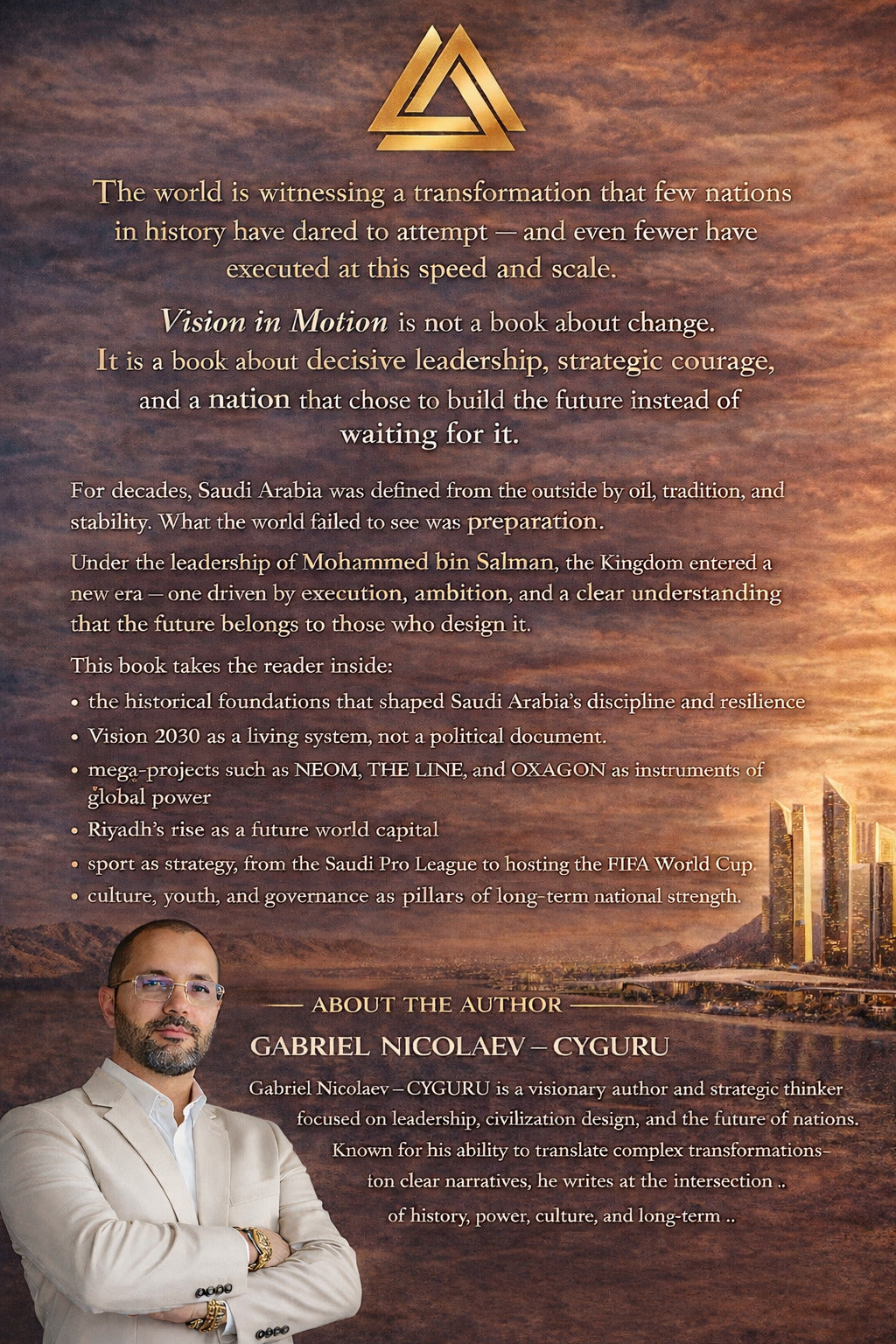
Vision in Motion is a strategic exploration of one of the most ambitious national transformations of the twenty-first century: the rise of Saudi Arabia from a resource-centered regional power into an increasingly diversified, globally connected, and strategically influential state.
Written by Gabriel Nicolaev — CyGuru, the book looks beyond the spectacular architecture, megaprojects, investment announcements, international events, and global headlines surrounding the Kingdom.
Its central subject is something deeper:
How does a nation transform vision into power?
Saudi Arabia is attempting something historically difficult — to modernize at extraordinary speed while preserving continuity, identity, sovereignty, and national cohesion.
At the center of this transformation stands Saudi Vision 2030, closely associated with the leadership of Crown Prince Mohammed bin Salman.
Yet Vision 2030 is examined here not simply as an economic diversification program.
It represents a broader reconfiguration of national capability.
Capital is being redirected. New industries are being constructed. Cities are being redesigned. Tourism is being opened at unprecedented scale. Culture and entertainment have become strategic sectors. Technology and artificial intelligence are moving toward the center of economic planning. Global sport has become an instrument of international visibility. Infrastructure is being conceived on generational rather than electoral timelines.
Projects such as NEOM, The Line, Qiddiya, Diriyah, the Red Sea developments, and the transformation of Riyadhreveal the physical dimension of this ambition.
But buildings alone do not create civilizations.
The deeper transformation concerns human capital, institutional capacity, national psychology, execution speed, economic confidence, and the ability of leadership to mobilize an entire society around a long-term direction.
Beyond Vision 2030
Vision in Motion explores Saudi Arabia through the interconnected forces shaping its future:
Leadership. Capital. Energy. Technology. Infrastructure. Culture. Identity. Geopolitics. Human capability. National ambition.
It examines how the Kingdom is positioning itself between East and West while maintaining strategic autonomy; how sovereign wealth is becoming an instrument of global influence; how economic diversification changes political power; and why geography, energy, investment capacity, demographics, and leadership have placed Saudi Arabia at an increasingly important intersection of the emerging world order.
The book also addresses something less visible but equally decisive:
The psychology of a nation in transformation.
Great transformations begin before cranes reach the skyline.
They begin when expectations change.
When a society stops asking whether transformation is possible and begins asking how quickly it can be executed, the psychological architecture of the nation itself has changed.
That shift may ultimately prove more consequential than any individual megaproject.
A Study of Power in Motion
This is therefore not merely a book about Saudi Arabia.
It is a study of statecraft, leadership, execution, national confidence, strategic patience, and civilization-scale ambition.
It asks why some nations remain trapped inside inherited structures while others develop the institutional and psychological capacity to redesign themselves.
It examines the difference between announcing a vision and constructing the machinery capable of delivering it.
And it considers the question that will define the coming decades:
Can Saudi Arabia transform extraordinary ambition into enduring national capability?
The answer will matter far beyond the Arabian Peninsula.
Because Saudi Arabia is no longer simply responding to the changing architecture of the world.
It is increasingly seeking a role in shaping it.
Gabriel Nicolaev — CyGuru
Gabriel Nicolaev — CyGuru writes about civilization, leadership, human psychology, systems, national transformation, and the deeper structures through which societies create power and continuity.
His work examines nations not merely through events, but through the invisible architecture behind them: vision, leadership psychology, institutional execution, collective identity, strategic intelligence, and the capacity to think beyond the present generation.
Vision in Motion forms part of this broader intellectual exploration of how leadership, culture, systems, and human ambition shape the trajectory of civilizations.
The future does not belong only to those who can imagine it. It belongs to those capable of building it.
Share